Custom Software vs. Off-the-Shelf: When Each Pays Off
 Von Manuel Gick·Certified AI & Automation Expert
The honest answer first: most of the time, off-the-shelf wins. We say that as an agency that builds custom software – which is exactly why you can trust the rest of this article. Whoever sells you a custom build for every problem is selling you their fee. Whoever tells you when standard is enough is selling you a decision. Here's the guide we walk through ourselves in every first conversation.
When off-the-shelf wins – more often than agencies admit
Standard software is software built for the many: accounting programs, CRM systems, project management tools, shop systems. It wins whenever your process looks like it does at most other companies.
And that's true more often than it feels. Writing invoices, managing vacation requests, coordinating appointments, sending newsletters – these processes aren't fundamentally different at your company than at the business next door. For all of them:
- Ready immediately. You buy, you set up, you work. No development time, no project risk.
- Battle-tested by countless companies. The teething problems were found and reported by others long ago.
- Updates included. New features, security patches, regulatory changes – the vendor takes care of it.
- Predictable costs. A monthly license instead of a development budget.
The rule of thumb: if your process is an everyday process, take the tool off the shelf. Building custom software for a standard process is like having a hammer forged because the one from the hardware store "doesn't quite fit your hand".
When custom software pays off: three clear cases
There are three situations where standard loses – and clearly.
1. When the process IS your business
Some processes aren't admin – they're the core of your company: how you quote, how you fulfill orders, how you produce. If you have to squeeze that core process into standard software, you adapt to the tool – not the other way around. You adopt the way of working the vendor designed for the average of its customers. For a peripheral process, that's fine. For the process you earn your money with, it's expensive: every extra click, every detour, every workaround the system "just can't do" multiplies with every order.
2. When interface gaps eat time
The most common case in practice: your individual systems are fine – they just don't talk to each other. The shop knows about the order, the inventory system doesn't. The CRM knows the customer, the accounting doesn't. In between sit people, retyping. What's needed here isn't a new all-in-one solution but the missing connector: a custom interface or a lean in-between system that links the programs you already have. Your systems stay. We dock on.
3. When the process is your competitive edge
Standard software makes everyone the same – that's its purpose. But if your customers buy from you precisely because you deliver faster, quote more flexibly or respond quicker than the competition, that edge lives in your workflows. Software anyone can buy can't capture that edge – otherwise everyone would have it. Custom software can. It cements your advantage instead of sanding it down to the industry average.
The hybrid path: keep standard, close the gaps with custom
In practice, the decision is rarely all-or-nothing. The path that pays off most often for small and mid-sized businesses is the third one: standard software for the standard processes, custom building blocks for the gaps in between.
Concretely, that looks like this: accounting, CRM and shop stay as they are – proven, paid for, mastered by the team. What's added is custom: the interface that moves orders from A to B automatically. The small backend that runs order processing. The agent that pre-sorts inquiries. No data migration, no retraining, no standstill – just the connection that was missing.
That's also why "custom software" almost never means "we'll build you a new ERP" with us. It means: we build exactly the piece you're missing. Nothing more. What that piece would be in your case is on our custom software page.
What it costs – honest numbers
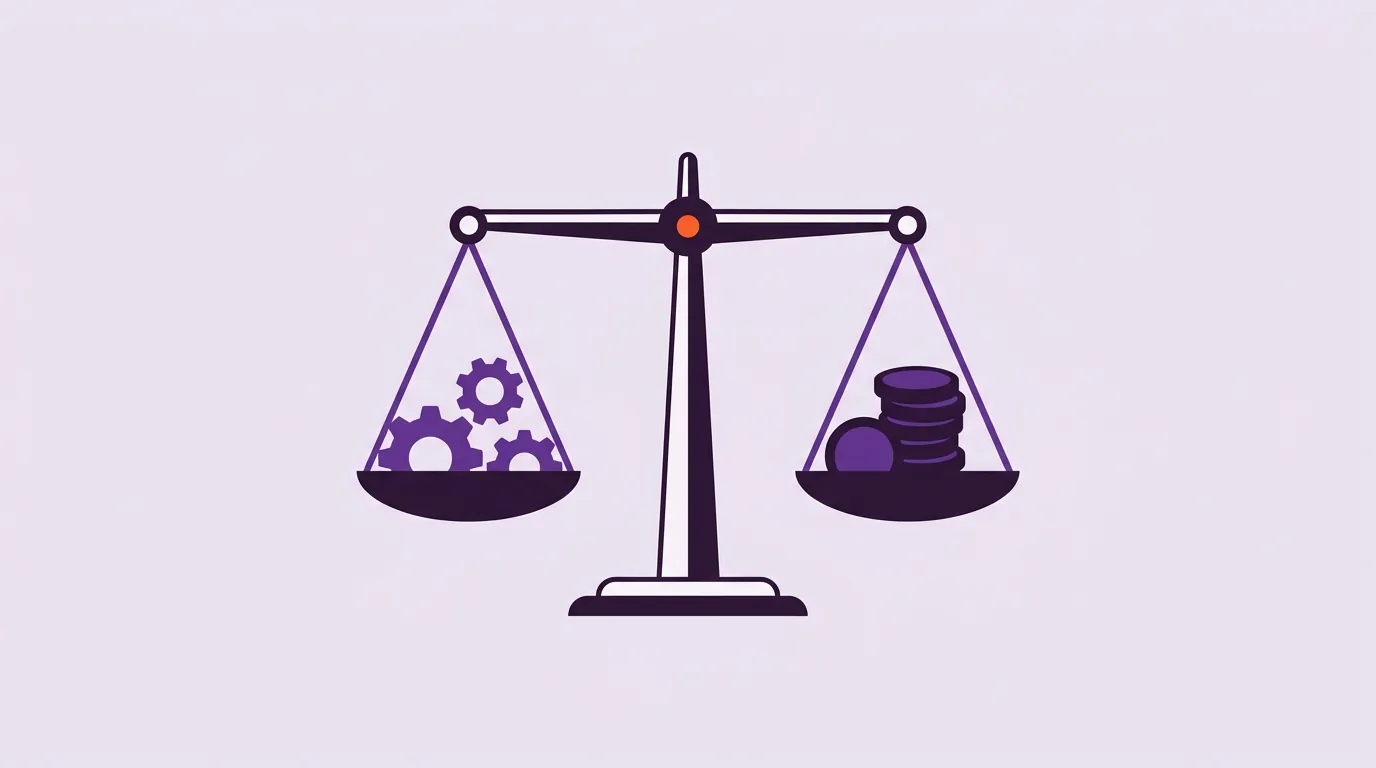
Custom software sounds like a six-figure budget and an endless timeline. For a long time it was – and for enterprise projects it still is. For SMEs, the math has changed: modern development tools have drastically cut the most expensive ingredient – development time.
With us, custom development runs as the SCALE² sprint: 3 weeks, 5 phases, from analysis to go-live, with 3 weeks of support included afterwards. Most SCALE² sprints fall between €2,500 and €13,000 – as a fixed price, agreed up front. That's not an enterprise IT budget. That's the price range of a used machine – for a tool that works alongside you every day.
But a fair comparison includes the other side too: standard software keeps costing – every month, per user, forever. Custom software costs once – plus maintenance. Which math works out better depends on the individual case. That's exactly why we run the numbers in the first conversation, before anyone builds anything.
The point both sides stay quiet about: dependency
One aspect is missing from almost every comparison, yet it decides things for years: who owns the solution?
With standard software, you're a tenant. The vendor sets the prices, the features and the moment they discontinue a product or change the terms. Usually that goes fine. But when your core process hangs on a tool whose future someone else decides, that's a risk that appears on no license invoice.
With custom software, you're the owner – the code belongs to you. In return, you carry the responsibility for upkeep: custom software needs maintenance too, or it ages. Serious development plans for that from day one instead of hiding it in the proposal.
The honest summary: for peripheral processes, renting is almost always smarter. For the process your business hangs on, ownership is an argument – not a decisive one, but one you should weigh deliberately instead of not at all.
A real example: from 30 minutes to 3
What the hybrid path looks like in practice: a family-run e-commerce company we worked with. The problem: every order passed through several systems that didn't talk to each other – about 30 minutes of manual work per order. At 30,000+ orders, that's a number you can't argue away.
The solution wasn't a new all-in-one system. The existing systems stayed – in between came a custom-built backend that automates order processing. Result: 3 minutes per order instead of 30. Minus 90%. The full story with all the details is in the backend optimization case study.
The point: not a single standard system was replaced. The custom software closed the gap – it didn't reinvent the wheel.
The decision checklist
Five questions to ask before any software decision:
- Is my process genuinely different from everyone else's? If not: standard.
- Is there a standard solution that at least roughly covers the process? If yes, and the rest is bearable: standard.
- Is the problem in the systems themselves – or in the gaps between them? Gaps between them: hybrid path, custom interface.
- Do I earn my money with this process? If yes, and standard forces compromises: custom.
- Have I compared both calculations – years of license fees versus one-time development? If not: calculate first, decide second.
Honest interim verdict: for most companies, this list leads to a mix – lots of standard, one or two custom building blocks where it hurts. Which tools come into play, from Make.com and n8n to custom code, is in our services overview. The tool follows the problem – never the other way around.
The next step
Whether your case is a standard case, a hybrid case or a genuine custom case can't be answered seriously from the outside – but pretty quickly in a conversation. That's what the time-potential analysis is for: 45 minutes, free, no sales pitch. You walk out with an honest assessment of which path pays off for you – even if the answer is: "buy it off the shelf." Book your time-potential analysis.