Agentic Coding & Claude Code: How AI Builds Software Today
 Von Manuel Gick·Certified AI & Automation Expert
For decades, software development meant one thing: a human types every line. That's changing right now – not as a promise about the future, but in the daily work of development teams, ours included. The term is agentic coding, and one of the leading tools for it is Claude Code. What's behind it, what it can really do, where its limits are – and why it might be the most important news for small and mid-sized businesses (SMEs) in years. No hype, promise.
What is agentic coding?
The first generation of AI tools for developers was autocomplete: the human writes, the AI suggests the next line. Useful, but at its core a typing aid.
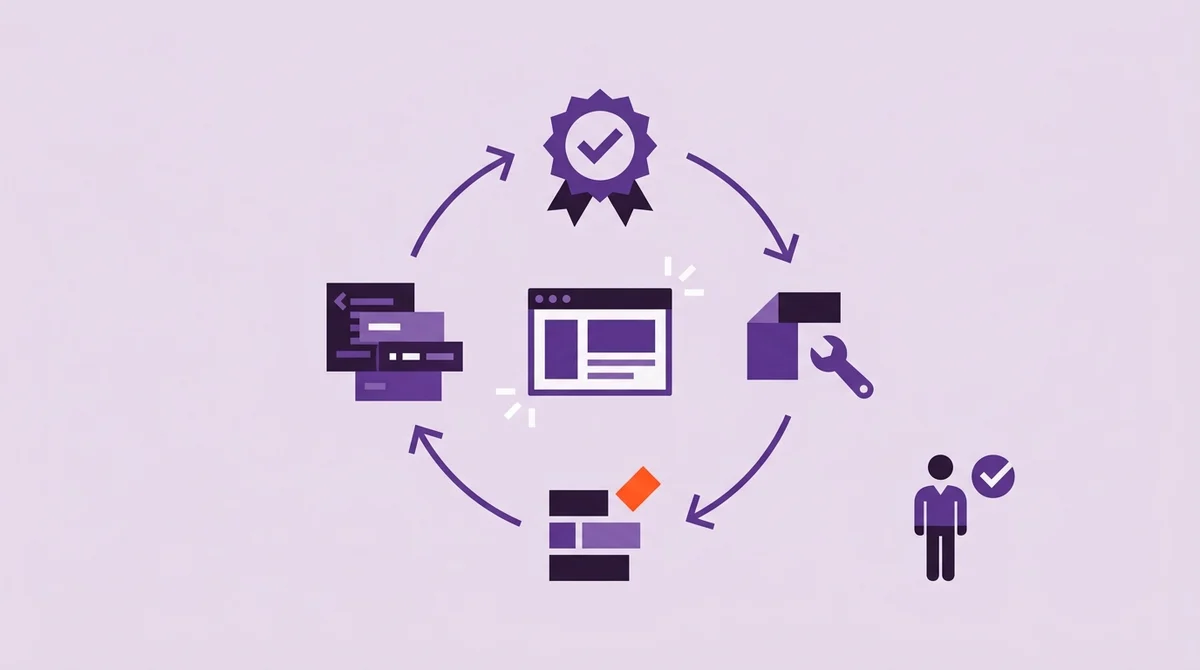
Agentic coding is something else. Here, the AI doesn't get a line – it gets a task: "Build an interface that transfers orders from the shop into the inventory system." The AI agent then reads the existing code, makes a plan, writes the necessary files, runs the code, tests it, finds its own mistakes – and fixes them. It works in loops: build, check, correct, until the result meets the requirements.
The difference from autocomplete is the same as between a spell-checker and an editor who researches, writes and proofreads an entire piece. A tool that helped with typing has become a tool that completes whole units of work on its own – under supervision.
"Under supervision" isn't a fig leaf here. It's the core of the method. More on that in a moment.
What is Claude Code?
Claude Code is the coding agent from Anthropic – the company behind the Claude AI models. It doesn't run as a chat window next to the work; it runs inside the project: it can read and understand the entire codebase, create and change files, execute programs, run tests and evaluate their results.
In practice, that means: a developer describes what should be built – as precisely as a good work order. Claude Code drafts a plan, the developer reviews and corrects it, then the agent implements. Along the way, it asks questions, shows intermediate results, documents decisions. The developer's role shifts: less typing, more sharpening requirements, reviewing plans, signing off on results.
Important context: Claude Code is a professional tool. It doesn't turn a layperson into a developer – but it turns an experienced developer into a small team. And that's exactly where the effect comes from that matters to you as a business owner.
Why this makes custom software affordable for SMEs
Custom software had one long-standing problem in the SME world: the most expensive line item in any software project is development time. A custom backend, a made-to-measure interface, an internal tool – technically, it was always possible. Economically, often not. The projects that penciled out were enterprise projects; SMEs got standard software and compromises.
Agentic coding shifts that math. When an experienced developer with an agent delivers in weeks what used to take months, projects become viable that never were before: the interface between two systems that "was never worth it for such a small thing". The internal tool for exactly your process. The automation that requests, checks and files a quote.
That's not a thought experiment – it's the reason our projects can run in a fixed, short format; more on that below. And it's why the question "standard or custom?" gets answered "custom" more often today than just a few years ago: the price of a perfect fit has dropped. What custom development covers with us is on the custom software page.
The honest limits
Now the part the hype articles skip. Agentic coding has limits, and ignoring them builds risk into your house:
- AI code isn't automatically good code. An agent writes fast and confidently – including when it's wrong. It can miss edge cases, introduce security holes or pick solutions that work today and that nobody wants to maintain tomorrow. Which is why one rule has no exceptions with us: all code is reviewed by experienced developers – nothing goes live unchecked.
- The requirements remain human work. The agent builds what it's told. Whether what's described actually solves your problem, whether the process was properly understood in the first place, which trade-offs sit behind it – no tool decides that. The hardest work in software projects was never the typing. It was the understanding. That hasn't changed.
- Responsibility can't be delegated. If your order processing hangs on this software, a human with a name carries the responsibility – not a model. Architecture, data protection, operations: human decisions.
- Agentic coding doesn't replace developers. It changes their work – from line-writer to architect and reviewer. Anyone telling you the AI will build your system "completely on its own" isn't selling you a project. They're selling you a risk.
In short: the tool is extraordinary. But it's a tool. The difference between a good outcome and a dangerous one lies in the hand that guides it.
How we use Claude Code in the SCALE² sprint
For us, agentic coding isn't an experiment – it's a built-in part of a fixed process. Our projects run in that sprint format: 3 weeks, 5 phases, from analysis to go-live. Most SCALE² sprints fall between €2,500 and €13,000 – as a fixed price, with 3 weeks of post-go-live support included.
The division of labor inside it is clearly defined:
- Analysis and concept: human. We sit with you at the process, not at the prompt. Which problem, which systems, which edge cases – no agent settles that.
- Implementation: human with agent. Our developers build with Claude Code. The agent speeds up the building; the developer steers, reviews intermediate results and makes the architecture decisions.
- Quality assurance: human. Review of every change, tests, sign-off with you. Nothing goes live unchecked – with us, that sentence is process, not marketing.
That we work with AI tools isn't a lucky brush with fashion: we've been building automation and software for SMEs since 2016, across 120+ projects – and we don't just use AI agents in development, we deliver them as a product. What an AI agent can take over in your day-to-day business is a topic of its own – the technology behind it is the same family.
What this means for you
You don't have to understand agentic coding to benefit from it – just as you don't have to strip an engine to drive a car. What you should know is simple: custom software has become affordable for SMEs. The question is no longer "Can we afford this?" but "Which of our problems pays off first?"
That's exactly the question the time-potential analysis answers: 45 minutes, free, no sales pitch. We look at your processes and tell you honestly whether and where custom development pays off for you – and where it doesn't. Book your time-potential analysis.
Does agentic coding replace software developers?
No. It changes their role: fewer lines typed, more requirements sharpened, architecture decided and results reviewed. Responsibility for quality, security and operations stays with humans – with us, all agent-written code is reviewed by experienced developers before it goes live.
Is software built with AI safe?
As safe as the process around it. AI-generated code goes through the same quality assurance with us as hand-written code: review by experienced developers, tests, sign-off. Nothing goes live unchecked. AI code only becomes risky where exactly that review is missing.
Is this worth it for smaller companies too?
Especially there. The biggest effect of agentic coding is that projects become viable that used to be too small for custom development – a single interface, an internal tool, an automation. Whether your case is one of them is what the time-potential analysis clarifies: 45 minutes, free.